Ask a child to sit still and memorize facts and you will lose them in minutes. Hand that same child a cup of water, some food coloring and a paper towel, and they will happily spend an hour watching the colors climb. That is the quiet power behind STEM activities for kids. They do not feel like lessons. They feel like play, and the learning slips in through the back door while nobody is looking.
STEM stands for science, technology, engineering and mathematics, four subjects that sound heavy on paper but come alive the moment a child gets to touch them. You do not need a lab or a big budget. Most of the best experiments use things already sitting in your kitchen drawers.
Why hands-on beats sitting still
Young children learn with their hands before they learn with their heads. When a five-year-old builds a tower and watches it topple, they are running a real experiment about balance and weight, even if they cannot name the physics. That physical, trial-and-error loop is exactly how the brain builds lasting understanding. Reading about gravity is forgettable. Knocking over a tower ten times is not.
This is also why STEM play holds attention so well. A worksheet has one right answer and a lot of pressure. A pile of blocks has a hundred answers and no pressure at all, so children keep going, and the longer they stay curious, the more they absorb.
Easy STEM activities for kids you can start today
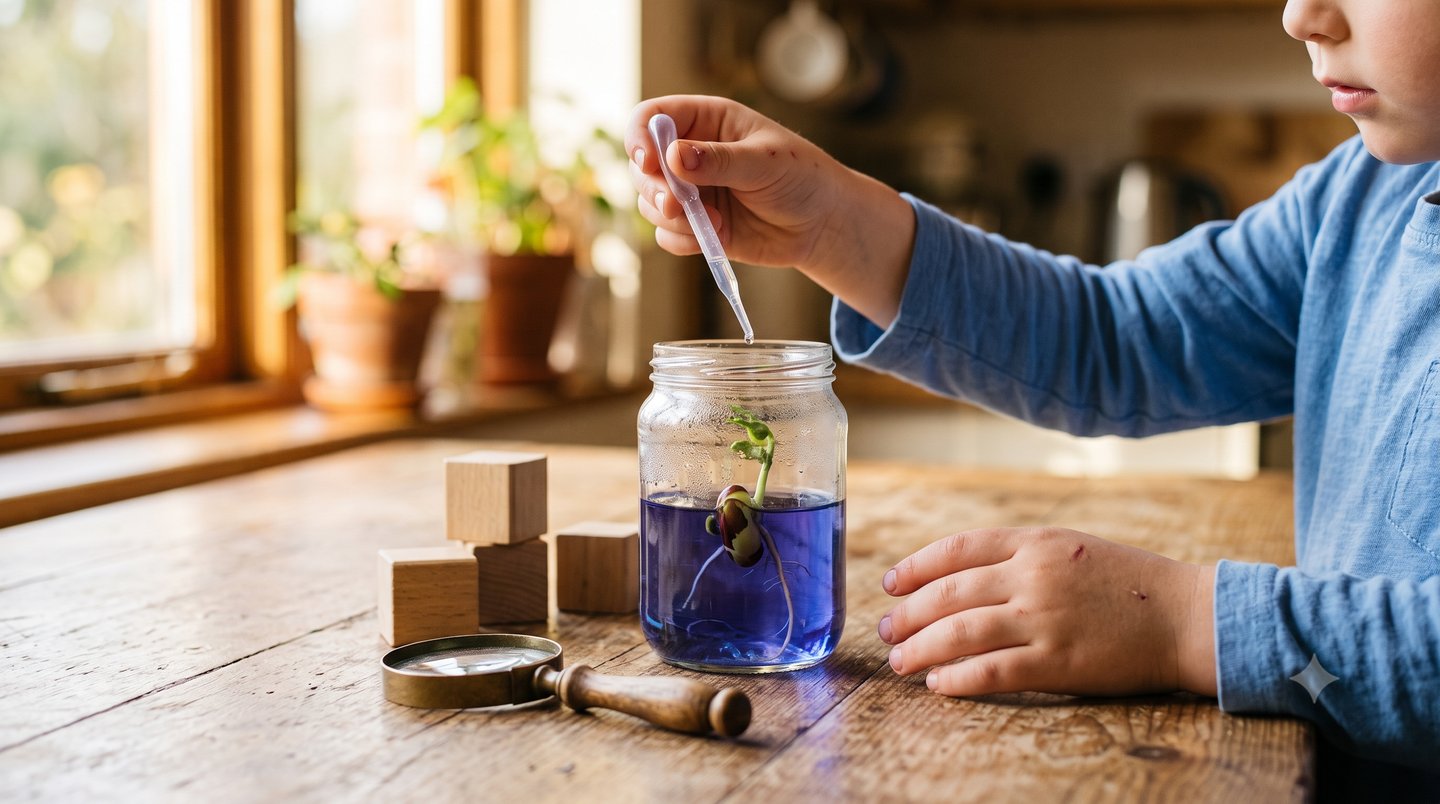
Some of the most effective easy STEM activities for kids take five minutes to set up. Float a few objects in a bowl of water and ask which will sink before dropping each one in. Build a ramp from a book and race toy cars to see how height changes speed. Grow a bean in a clear jar so the roots stay visible. Mix baking soda and vinegar and let the fizz do the teaching. Each one plants a question, and questions are the engine of every science.
The trick is to resist explaining everything up front. Ask what they think will happen, let them guess, then let the result surprise them. That gap between prediction and reality is where real learning lives.
Matching activities to age
What works for a toddler will bore a ten-year-old, and what challenges a ten-year-old will frustrate a toddler. Simple learning activities for toddlers lean on sorting, stacking and pouring, the raw building blocks of math and physics. Older children can handle multi-step projects, like building a marble run or wiring a tiny circuit with a battery and a bulb.
Board games belong here too. The best educational board games for kids sneak in counting, strategy and pattern recognition without a single worksheet. A game night can carry as much learning as a formal lesson, and it comes with laughter attached.
Keeping curiosity alive as they grow
The goal is not to raise a child who can recite facts. It is to raise one who keeps asking why. When kids see that questions lead to interesting answers, they carry that hunger into every subject, including languages. The same curiosity that drives a kitchen experiment can just as easily fuel learning a new language, another skill that rewards patient, playful practice.
As children move into the school years, those early habits of exploring, testing and reflecting quietly become the foundation for how they will study effectively later on. A child who learned that mistakes are just data will not fall apart over a wrong answer on a test.
You do not need to be an expert
Plenty of parents worry they cannot teach STEM because they were never good at it themselves. Good news: you do not have to be. Your job is not to have the answers, it is to ask good questions and share the wonder. "I don't know, let's find out" is one of the most powerful sentences a parent can say. It turns you from a teacher into a fellow explorer, and children love company on an adventure.
If you want ideas and encouragement, communities of parents and teachers such as r/homeschool swap simple experiments and honest reviews of what actually holds a child's attention. Borrow freely, adapt to your own kids, and do not be afraid to make a mess. The mess is often where the memory forms.
Making it a habit, not an event
The families who get the most from this do not run elaborate science fairs. They keep a small box of supplies within reach and let ten curious minutes happen whenever they arise, at breakfast, in the bath, on a rainy afternoon. Little and often beats one big project that never gets repeated. When exploring becomes an ordinary part of the week, children stop seeing it as school and start seeing it as simply how their family looks at the world.
The lasting payoff
STEM activities for kids are not about producing tiny scientists. They are about protecting the natural curiosity every child is born with and giving it room to grow. Do a little often, follow their interests, and let play do the heavy lifting. The facts will come and go, but the habit of wondering out loud will stay with them for life.